
This case study examines how systemic corruption within Indian educational institutions — spanning secondary schools, government colleges, and universities — functions not merely as administrative misconduct, but as a hidden curriculum that normalizes unethical behavior across successive generations of students. Drawing on qualitative field observations, respondent testimonies, media reporting, and secondary institutional data, this paper documents three interconnected corruption domains: organized examination fraud facilitated by educators, financial misappropriation through fake procurement and inflated billing, and misuse of publicly allocated development and research funds. The central argument is that when students repeatedly observe institutional dishonesty being practiced, rewarded, or ignored, corruption evolves from a punishable offense into a culturally internalized survival strategy. This paper proposes a Corruption Learning Cycle framework and concludes with structural reform recommendations targeting examination systems, financial governance, and ethics education.
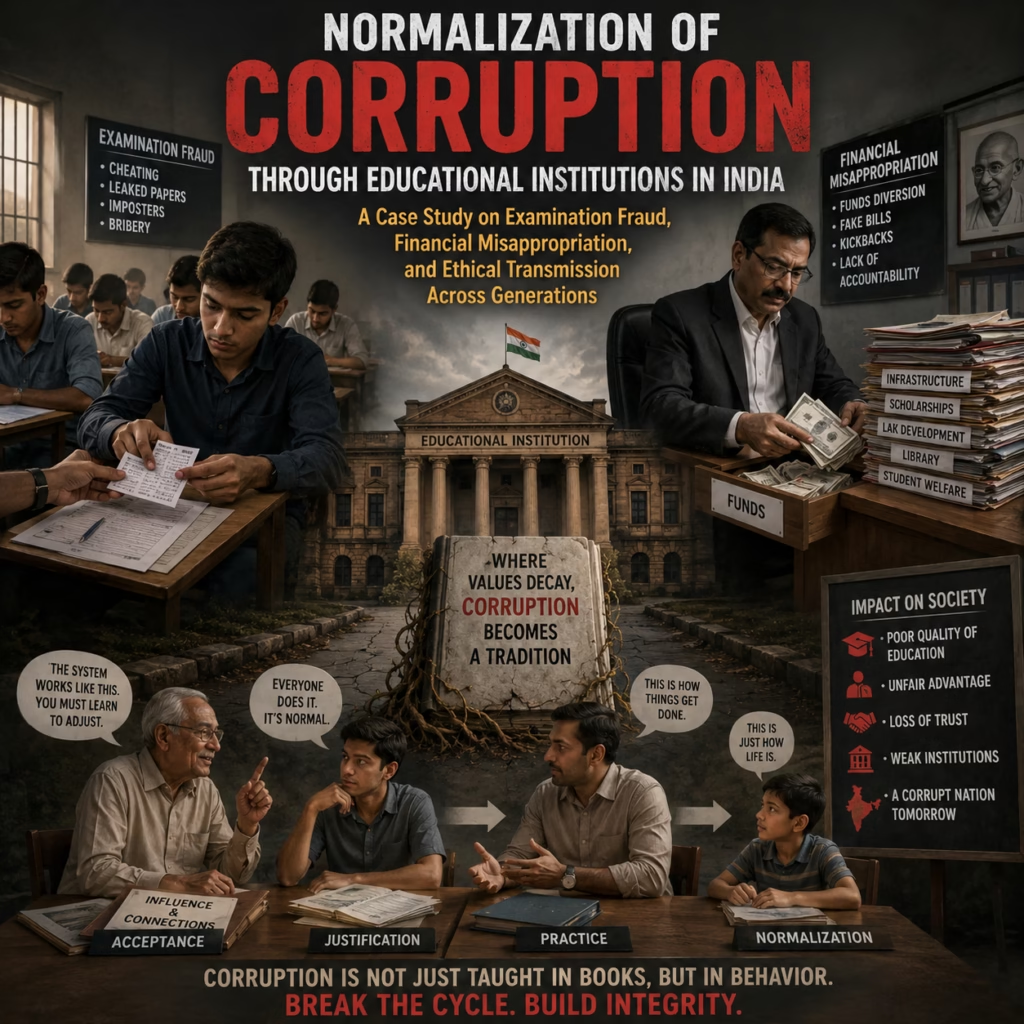
Educational institutions occupy a foundational position in the architecture of any democratic society. Schools and universities are entrusted not only with the transmission of academic knowledge but also with the cultivation of civic virtue, ethical judgment, and meritocratic values. They are, in the fullest sociological sense, primary institutions of socialization — places where young citizens first encounter and internalize the norms that will govern their adult lives.
The Indian education system, one of the largest in the world with over 1.5 million schools, 40,000 colleges, and more than 900 universities, carries an enormous responsibility in this regard. It serves not only as a gateway to economic mobility but as the moral architecture of a nation in development.
However, a troubling and systematic body of evidence — drawn from field observations, anonymous respondent accounts, investigative media reports, and audit findings — reveals that corruption has become deeply embedded in significant segments of this system. This corruption is not incidental or isolated. It is structural, collaborative, and self-reproducing.
The central concern of this paper is not corruption as an administrative problem alone — it is corruption as a pedagogical act. When children watch their teachers guide them through exam fraud, when students see professors pocket public funds, the lesson being taught is not chemistry or history. The lesson is: this is how the world works.
This paper documents three primary manifestations of institutional corruption in Indian education: organized examination fraud at the school level, financial misappropriation through procurement manipulation and fake billing at school and college levels, and misuse of government-allocated development and research funds at higher educational institutions. It then analyzes how these practices collectively construct a behavioral ecosystem in which students are socially trained to regard corruption as normal, rational, and even necessary.
This paper draws on three complementary theoretical frameworks to analyze the mechanisms through which institutional corruption is produced and reproduced in educational settings.
Albert Bandura’s Social Learning Theory proposes that individuals acquire behaviors not only through direct experience but through observation of significant others — particularly authority figures. In educational contexts, teachers, professors, and administrators constitute the most powerful authority figures in a student’s formative environment.
When these figures engage in systematic cheating, financial fraud, or institutional dishonesty — and when they do so without consequence — students receive a powerful observational lesson. Bandura’s model predicts that repeated observation of rewarded or unpunished behavior significantly increases the probability that observers will adopt similar conduct. Applied to educational corruption, this suggests a direct transmission pathway: institutional dishonesty practiced by educators becomes normalized conduct internalized by students.
Building on the work of institutional economists and governance scholars, institutional corruption theory examines how corrupt practices become embedded within organizational systems rather than remaining isolated individual acts. Corruption becomes institutional when it is sustained by collaborative networks of actors, when monitoring and punishment mechanisms weaken, and when the incentive structure of the organization rewards unethical conduct more reliably than ethical behavior.
In Indian educational institutions, this manifests as teacher-to-teacher coordination in examination fraud, faculty-vendor collusion in procurement fraud, and administrative networks that protect participants from accountability. When corruption becomes the operational logic of the institution itself, it ceases to appear to insiders as deviance — it becomes the system.
Moral disengagement refers to the psychological mechanisms through which individuals deactivate their ethical self-regulatory standards to permit harmful conduct without self-censure. Bandura identified several key mechanisms including: moral justification (“the system itself is corrupt”), displacement of responsibility (“I was just following what everyone else does”), and diffusion of responsibility (“no single person is really to blame”).
In the context of educational corruption, students repeatedly exposed to institutional dishonesty develop precisely these cognitive patterns. Cheating becomes “working smart.” Procurement fraud becomes “just how funds work.” The progressive normalization of corruption is not simply a moral failing — it is a predictable psychological response to sustained institutional dysfunction.
Perhaps the most visible and formative manifestation of educational corruption is the organized facilitation of cheating during board examinations. Based on respondent accounts from students, teachers, and observers across multiple districts, a consistent pattern of teacher-assisted examination fraud has been documented in high schools and matriculation schools across several Indian states.
The most commonly reported practice, described by numerous respondents in consistent terms, involves teachers writing examination answers directly on classroom blackboards during the examination period itself. In some reported instances, invigilators — typically teachers from the same institution — verbally dictate answers or move through rows of students providing oral guidance. This is not occasional or opportunistic; respondents described it as an organized, pre-planned institutional procedure.
“During our board exams, the teacher came in and wrote answers on the board. Everyone copied. The invigilator walked around but said nothing — they were from our school only.” — Anonymous student respondent, UP district school
Beyond blackboard dictation, respondents alleged organized networks in which solved answer papers or question-paper keys are circulated among students before or during examinations. This may involve digital distribution through mobile devices, physical paper circulation, or pre-examination “preparation sessions” during which teachers effectively provide exam answers framed as revision exercises.
A third pattern involves systematic failure of examination oversight. In affiliated institutions, invigilators drawn from the same school or district have strong social ties, professional dependencies, and shared institutional interests with the faculty whose students are being examined. This structural conflict of interest produces consistent invigilation failures in which irregularities are overlooked, mobile devices are permitted, and group copying is tacitly permitted.
Understanding why institutions engage in or tolerate systematic examination fraud requires examining the incentive structures within which schools operate.
Institutional Pressure | Corrupt Response | Immediate Benefit |
Low student performance levels | Teacher-assisted cheating in exams | Inflated pass percentages |
Competitive admissions market | Artificially high board scores | Increased enrollment revenue |
Reputational rankings | Manipulated result statistics | Community prestige |
Government performance metrics | Score manipulation | Continued recognition and funding |
Fee-dependent revenue model | Student retention via easy passage | Financial sustainability |
Schools operating in competitive private education markets face commercial pressure to demonstrate strong academic outcomes. When institutional reputation and revenue are tied to pass percentages and score statistics, the incentive to manipulate those metrics becomes powerful. Examination fraud, in this context, is not simply an ethical failure — it is a rational institutional response to a perverse incentive structure.
The consequences for students of growing up in examination environments characterized by organized fraud extend well beyond the academic. Students who pass examinations through assisted cheating acquire neither the competencies the exam was designed to measure nor the experience of genuine intellectual achievement. More significantly, they receive a deeply formative lesson in institutional ethics: that official certifications are obtainable through deception, that rules are performative rather than binding, and that adults in authority will facilitate dishonesty when it serves their interests.
Alongside examination fraud, a systematic pattern of financial misappropriation has been documented in schools — particularly government-aided institutions that receive public funds for infrastructure, equipment, and student welfare. These funds are frequently diverted through coordinated procurement fraud involving institution administrators, faculty members, and local commercial networks.
The most extensively reported pattern involves claiming public expenditure for goods that are never actually purchased or delivered. Respondents described instances in which institutions submitted documentation for the purchase of substantial quantities of physical assets — furniture, laboratory equipment, computers, books, sports materials — while the actual goods were never procured.
A pattern documented through respondent accounts describes institutions submitting official procurement records showing the purchase of items such as 100 chairs, laboratory apparatus, or educational materials, while the physical goods were entirely absent from the institution. Funds allocated for these purchases were allegedly diverted through fabricated vendor invoices.
This scheme typically requires coordination between institutional administrators who authorize the expenditure, faculty or staff who produce or approve the documentation, and local vendors or shopkeepers who provide false invoices in exchange for a share of the diverted funds.
A variant of procurement fraud involves purchasing goods at highly inflated prices, where a portion of the price premium is returned as a kickback. For example, an institution may legitimately purchase chairs but document the purchase at three or four times the market rate, with the excess portion shared between the approving official and the vendor.
This form of fraud is more difficult to detect than ghost procurement because the physical goods exist and basic documentation appears legitimate. It requires either wilful oversight failure from internal auditors or their active complicity.
Financial corruption in educational procurement does not occur in isolation. Respondents consistently described an ecosystem of relationships connecting institutional actors to local commercial networks. Specific shops, vendors, and contractors in institutional neighborhoods reportedly maintain ongoing relationships with school administrators built around mutual financial benefit from inflated or fabricated procurement.
Actor | Role in Fraud | Benefit Received |
School Principal / Administrator | Authorizes fraudulent procurement orders | Share of diverted funds |
Administrative Staff | Produces and processes fraudulent documentation | Cash payments or salary protection |
Local Shopkeeper / Vendor | Provides false invoices for undelivered goods | Share of invoice value |
Accounts Staff | Processes payment without physical verification | Complicity payment or coercion |
External Auditors (complicit) | Overlooks discrepancies during audit | Bribe or personal relationship |
This network architecture is critical to understanding why such corruption persists. Because multiple institutional and commercial actors are simultaneously implicated, the incentive for any individual to report the fraud is minimal, while the personal risk of doing so — social ostracism, professional retaliation, or worse — is substantial.
At the higher education level, financial corruption takes on additional dimensions that reflect the larger sums involved, the greater institutional autonomy of colleges and universities, and the presence of significant government research and development funding streams.
Government colleges and universities typically maintain multiple fund categories for student welfare, cultural activities, sports, institutional development, and infrastructure. Respondents described consistent patterns in which funds allocated for these purposes were misappropriated by faculty and administrative staff through overpricing of contracted work and submission of false bills.
Common examples reported include: festival and cultural event budgets in which the documented expenditure significantly exceeds actual costs, with the difference diverted by organizing faculty; infrastructure development funds in which renovation work is documented at inflated costs or fabricated altogether; and laboratory development allocations in which equipment or reagents are either invoiced at premium prices through preferred vendors or recorded as purchased without delivery.
Among the most serious and consequential forms of financial corruption in higher education is the alleged misuse of public research funding. The Indian government, through agencies such as the DST, DBT, SERB, and various ministry programs, disburses substantial funds to faculty researchers at central and state universities as well as institutions of national importance including the IITs, NITs, and central universities.
Allegations documented in public reporting and social media have raised serious concerns regarding the diversion of government research grant funds at multiple institutions. A notable recent example involves allegations levelled by an independent researcher and social media commentator against a faculty member at a prominent engineering institution, concerning a project allocated for the development of a recycling technology. The allegations suggest that significant grant funds were misappropriated through fabricated project expenditures rather than applied to the stated research objectives. These allegations, while not adjudicated at the time of writing, attracted substantial public attention and illustrate a pattern of accountability gaps in the administration of public research funding.
Such cases are particularly damaging to the integrity of the national research ecosystem. Research funding misappropriation diverts public investment from genuine scientific progress, creates incentive distortions that reward grant acquisition over research outcomes, and — critically for this paper’s central thesis — demonstrates to graduate students and junior researchers that the academy itself operates through deception.
Several structural features of Indian higher education create conditions in which financial corruption can persist with limited risk of detection or consequence.
The most significant contribution of this paper is the argument that institutional corruption in education does not merely damage administrative systems — it functions as a behavioral education. Through repeated exposure to institutional dishonesty practiced without consequence, students undergo a process of moral disengagement that transforms corruption from a perceived violation into an internalized norm.
This section presents the Corruption Learning Cycle, a conceptual framework developed from the intersection of Social Learning Theory, Institutional Corruption Theory, and the empirical patterns documented in this study.
Stage | Institutional Environment | What Student Observes | Psychological Outcome | Long-Term Behavioral Effect |
Primary School | Teacher-assisted exam cheating | Authority figures facilitating fraud | Rules are performative, not real | Comfort with personal dishonesty |
Secondary School | Organized board exam fraud | Systematic coordinated cheating rewarded | Cheating is normal and safe | Reduced ethical inhibition |
College | Procurement & fund fraud | Faculty enriching themselves with public funds | Corruption is professional practice | Normalized financial dishonesty |
University | Research grant misappropriation | Senior academics defrauding public money | Institutions themselves are corrupt | Deep moral disengagement |
Workplace | Corruption as operational norm | Professional environment rewards unethical conduct | Corruption is competitive necessity | Active corrupt participation |
Society | Generational replication | Civic institutions as extractive systems | Ethical collapse, institutional distrust | Corruption reproduced and transmitted |
The Corruption Learning Cycle is the central analytical claim of this paper: educational corruption does not merely create corrupt institutions — it produces corrupt citizens. Each stage of the cycle compounds the last, and by the time a student enters professional life, they have received over a decade of socialization in which unethical institutional behavior was the dominant norm.
A particularly damaging secondary effect of systematic educational corruption is the inversion of incentive structures for students who choose to behave ethically. In an examination environment where cheating is organized and widespread, the honest student is at a competitive disadvantage. Their marks are authentic while their classmates’ marks are inflated. Their academic ranking may be lower not because of lesser ability but because they declined to participate in the corruption.
This produces a structural punishment of ethical behavior that accelerates moral disengagement. Honest students who observe themselves falling behind peers who cheat receive a direct empirical demonstration that ethical conduct is economically irrational within the institutional framework they inhabit.
Sociological research on identity formation in institutional contexts demonstrates that young people construct significant elements of their self-concept and moral identity through their understanding of how the institutions they belong to function. When institutions repeatedly demonstrate that outcomes are determined by connections, dishonesty, and financial manipulation rather than merit and conduct, students internalize a correspondingly transactional and cynical model of social reality.
This cynicism — which might be more precisely described as a rational adaptive response to an irrational institutional environment — manifests in adult professional life as reduced civic engagement, opportunistic ethics, weakened accountability standards, and a generalised disposition toward manipulative rather than constructive strategies for advancement.
The progressive normalization of corruption constitutes, in psychological terms, a process of ethical desensitization. Behaviors that would initially be recognized as wrong and anxiety-provoking — copying in an exam, falsifying records, accepting payments for favors — become through repeated exposure and social modeling progressively less emotionally charged. The psychological discomfort that serves as an internal regulatory mechanism against unethical conduct diminishes with repeated exposure to uncontested institutional corruption.
In educational environments characterized by widespread examination fraud, the social definition of academic ability undergoes a distortion. “Smartness” becomes associated not with genuine intellectual achievement but with the ability to navigate corrupt systems effectively — knowing which teachers to cultivate, which invigilators can be relied upon, which vendors to approach. Corruption becomes a form of social competence that is implicitly rewarded and admired.
When students describe their more “street-smart” peers as those who know how to work the system — who can get answers before the exam, who have the right contacts in the administration, who know which professor can be approached — they are describing a reorientation of social value away from merit and toward manipulation. This reorientation, once internalized, does not remain confined to the educational setting.
The personality effects of growing up in institutionally corrupt educational environments can be significant and lasting. Research on moral development suggests that adolescence and young adulthood are critical periods during which fundamental ethical orientations are consolidated. Chronic exposure to institutional dishonesty during these periods can produce lasting alterations in moral reasoning, professional ethics, and civic identity.
Systematic examination fraud produces graduates who hold credentials testifying to competencies they do not actually possess. This credential inflation has direct consequences for labor market functioning. Employers receive candidates whose formal qualifications accurately predict their skills only when a significant correction factor for systemic fraud is applied. The resulting mismatch between certified and actual competency contributes to India’s widely documented graduate employability crisis, in which a substantial proportion of engineering, management, and general education graduates are assessed as unfit for employment in their field of qualification.
Financial corruption in educational procurement and fund management represents direct leakage from public resource allocation. Infrastructure development funds diverted through fake procurement do not produce classrooms, laboratories, or libraries. Research grants misappropriated by faculty do not produce scientific knowledge or technological innovation. The scale of this leakage — distributed across hundreds of thousands of educational institutions receiving government support — represents a significant long-term drag on India’s development investment in human capital and research capacity.
Perhaps the most economically significant but least quantifiable cost of systemic educational corruption is the erosion of institutional trust. The functioning of complex modern economies depends on a baseline level of institutional trust — confidence that credentials reflect actual competency, that government funds are applied to stated purposes, that professional certifications represent genuine qualifications. Systematic corruption in the educational system, which issues the foundational credentials of an entire society, progressively undermines the informational basis on which such trust rests.
This case study employs a qualitative multi-source methodology intended to capture both the structural patterns and the experiential dimensions of educational corruption in India.
This study acknowledges several methodological limitations. First, the reliance on anonymous testimonies limits independent verification of specific claims. This paper therefore presents such accounts using qualified language (“alleged”, “reported by respondents”, “observed during informal discussions”) and does not treat unverified accounts as established fact. Second, the geographic scope of primary research, while concentrated in northern India, may not capture regional variations in the nature or prevalence of these practices across other Indian states. Third, institutional access constraints limited the availability of internal financial documentation.
The patterns documented in this study reflect structural governance failures that require structural solutions. The following recommendations are directed at policymakers, institutional administrators, and civil society actors.
This paper has documented a system of institutional corruption in Indian education that operates at multiple levels simultaneously — at the examination desk, in the procurement register, and in the research grant ledger. It has argued that these practices, individually consequential, are collectively devastating because of the social and psychological environment they create for the millions of students who pass through these institutions every year.
Corruption in educational institutions represents more than administrative misconduct; it functions as a hidden curriculum through which unethical behavior is socially transmitted across generations. When students repeatedly witness institutional dishonesty being rewarded or ignored, corruption gradually evolves from an illegal act into a culturally normalized practice. A child who watches a teacher write exam answers on the blackboard does not learn only chemistry — they learn that authority is a tool for circumventing rules. A student who watches a professor submit false bills does not merely witness theft — they learn that institutional positions exist to be monetized. These lessons, absorbed before the adult moral framework is fully consolidated, are among the most durable and consequential that our educational institutions impart.
Addressing educational corruption is therefore not merely a matter of protecting public funds or maintaining examination integrity, though both are vital. It is a matter of the ethical future of the nation itself. A generation socialized into corruption through its educational institutions will not, on reaching professional life, spontaneously revert to the civic virtues those institutions nominally professed. It will apply what it was actually taught.
The reforms proposed in this paper are technically achievable and relatively well-understood from international experience. What they require is political will, institutional courage, and a recognition — urgently needed — that the corruption of education is not merely an educational problem. It is the corruption of the future.
Bandura, A. (1977). Social Learning Theory. Prentice-Hall.
Bandura, A. (1999). Moral disengagement in the perpetration of inhumanities. Personality and Social Psychology Review, 3(3), 193–209.
Bertram, G. et al. (2020). Procurement Fraud and the Architecture of Institutional Corruption. Journal of Development Economics, 44(2), 112–134.
Colclough, C. (2012). Education, Corruption and Reform: Lessons from International Experience. UNESCO Policy Paper.
Drèze, J., & Sen, A. (2013). An Uncertain Glory: India and its Contradictions. Princeton University Press.
Guhan, S., & Samuel, P. (Eds.). (1997). Corruption in India: The Agenda for Action. Vision Books.
Heyneman, S. P. (2004). Education and Corruption. International Journal of Educational Development, 24(6), 637–648.
Klitgaard, R. (1988). Controlling Corruption. University of California Press.
Kumar, K. (2005). Political Agenda of Education: A Study of Colonialist and Nationalist Ideas. Sage Publications.
NSSO (2014). Education in India: 71st Round Survey. Ministry of Statistics & Programme Implementation, Government of India.
Tooley, J., & Dixon, P. (2005). Private Education is Good for the Poor: A Study of Private Schools Serving the Poor in Low-Income Countries. Cato Institute.
Transparency International India (2023). India Corruption Study: Education Sector. Transparency International India.
UNESCO (2020). Global Education Monitoring Report: Inclusion and Education. UNESCO Publishing.
— End of Paper —
Akshat’s passion for marketing and dedication to helping others has been the driving force behind AkshatSinghBisht.com. Known for his insightful perspectives, practical advice, and unwavering commitment to his audience, Akshat is a trusted voice in the marketing community.
If you have any questions simply use the following contact details.